Mindmap
What is a Mindmap?
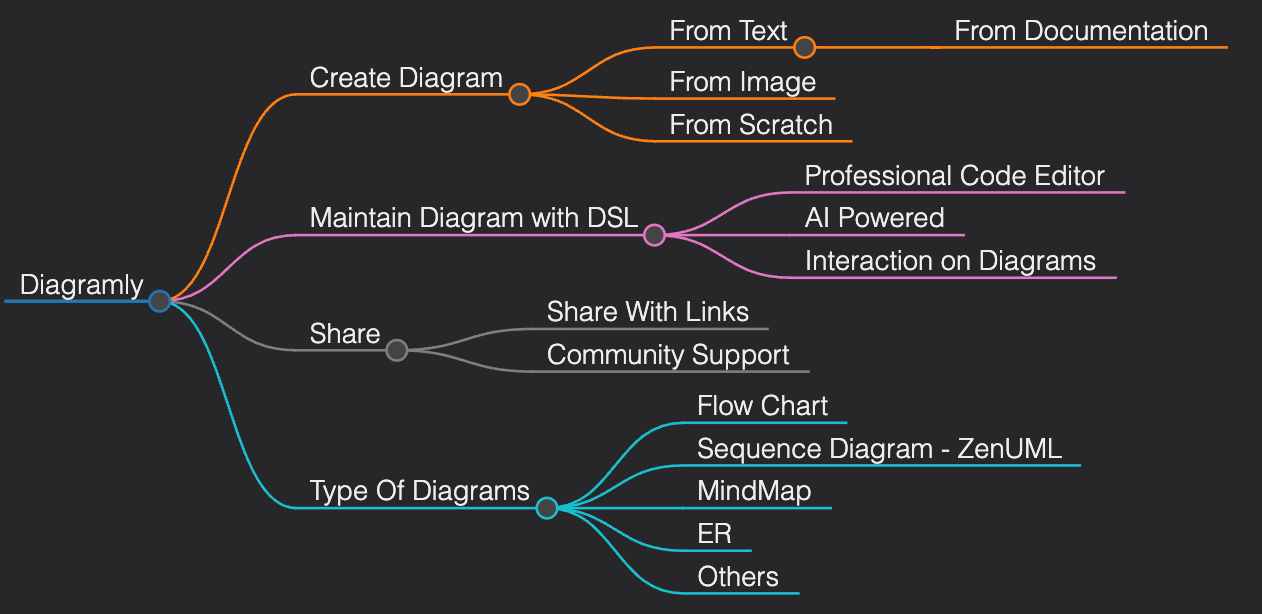
A mindmap is a visual tool used to organize information in a hierarchical and radial structure. It typically starts with a central idea or concept, from which related ideas, tasks, or concepts branch out. This branching structure allows for a natural organization of thoughts and information, mirroring the way our brains connect and categorize ideas.
Key characteristics of mindmaps include:
- A central topic or main idea
- Branches radiating from the center, representing subtopics or related concepts
- Use of colors, images, and keywords to enhance memory retention and visual appeal
- Hierarchical structure, with main branches subdividing into smaller branches
Example of Mindmap:
Best Practices for Creating Mindmaps
-
Start with a clear central idea: Begin with a well-defined main topic at the center of your map.
-
Use single keywords or short phrases: Keep your ideas concise to maintain clarity and ease of reading.
-
Employ a hierarchical structure: Organize information from general to specific as you move from the center outwards.
-
Utilize colors and images: Enhance visual appeal and memory retention by using different colors for branches and adding relevant images.
-
Keep it simple: Avoid overcrowding your mindmap. If a branch becomes too complex, consider creating a separate mindmap for that subtopic.
-
Use curved lines: Curved branches are more visually appealing and can help in creating a more organic flow of ideas.
-
Review and revise: Regularly review your mindmap and reorganize information as needed to ensure it remains relevant and effective.
Practical Applications of Mindmaps
Mindmaps can be valuable in various scenarios. Here are some examples:
-
Brainstorming:
- Scenario: A marketing team generating ideas for a new product launch.
- Example: “Product X Launch” as the central topic, with branches for “Target Audience”, “Marketing Channels”, “Key Features”, etc.
-
Note-taking:
- Scenario: A student summarizing key points from a history lecture.
- Example: “French Revolution” as the central topic, with branches for “Causes”, “Key Figures”, “Timeline”, “Consequences”, etc.
-
Project Planning:
- Scenario: An event planner organizing a corporate conference.
- Example: “Annual Tech Conference” as the central topic, with branches for “Venue”, “Speakers”, “Schedule”, “Marketing”, “Budget”, etc.
-
Problem-solving:
- Scenario: A team addressing customer service issues in a retail store.
- Example: “Improve Customer Service” as the central topic, with branches for “Staff Training”, “Queue Management”, “Feedback System”, “Store Layout”, etc.
-
Personal Goal Setting:
- Scenario: An individual planning their career development.
- Example: “Career Growth” as the central topic, with branches for “Skills to Develop”, “Networking”, “Education”, “Job Opportunities”, etc.
By visualizing information in this structured yet flexible format, mindmaps can help in generating ideas, organizing thoughts, and seeing connections that might not be apparent in linear note-taking or planning methods.